


$3.5 million police boats commissioned to boost border security

Two new police patrol boats built at a combined cost of approximately $3.5 million have been commissioned to strengthen border security in the Turks and Caicos Islands, boosting the country’s capacity to intercept illegal migrant vessels, disrupt organised crime and respond to emergencies at sea.
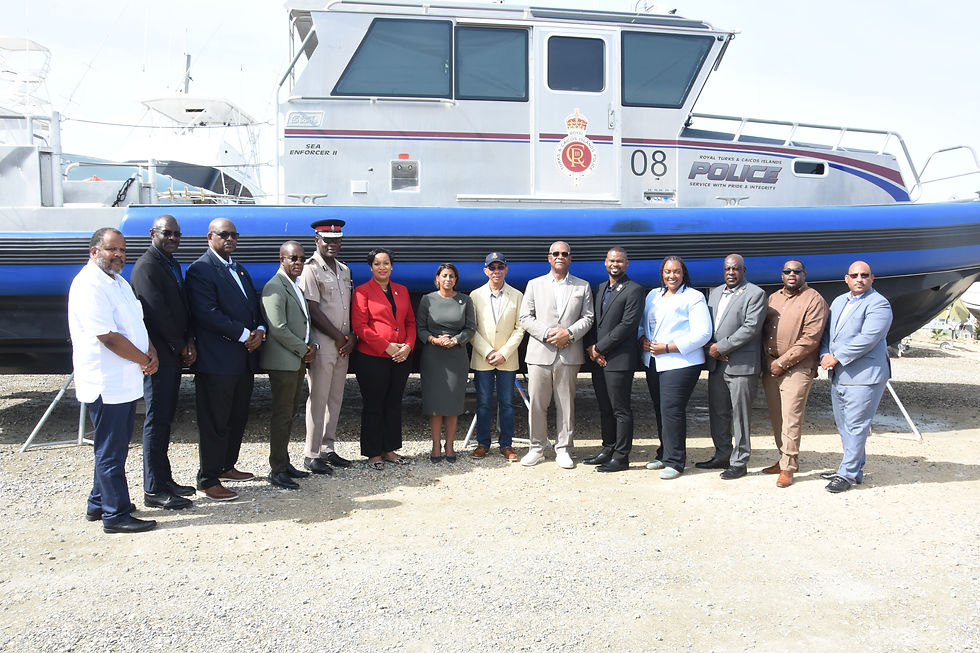
Sea Guardian II and Sea Enforcer II join the Royal Turks and Caicos Islands Police Force’s marine fleet as officials seek to improve surveillance and enforcement across the archipelago’s waters.
Regional cooperation featured prominently at the ceremony, attended by Jamaica’s Deputy Prime Minister and Minister of National Security and Peace, Dr. Horace Chang, and senior Jamaican police officials.
Speaking at the commissioning ceremony on Thursday, October 1, at South Bank Marina in Long Bay, Providenciales, Premier Charles Washington Misick said the vessels took 18 months to build and represented a tangible result of the government’s commitment to financing national security.
He said the acquisition formed part of a broader investment in policing, defence and the justice system, with public safety essential to sustaining the country’s tourism-dependent economy.
“We’re investing heavily in our equipment, as I said earlier, because we refuse to ask our officers to fight modern, sophisticated security threats with outdated tools,” Misick said.
The premier said the vessels would help deter smugglers, poachers and transnational criminals while protecting fishermen, coastal communities and vital economic infrastructure.
The boats will also strengthen search and rescue operations.
He also pledged continued support for the marine officers who will operate the boats, recognising that equipment alone could not replace the courage and integrity required of those serving on the front line.
Commissioner of Police Fitz Bailey said the new vessels would strengthen the force’s ability to protect the borders and respond to the challenges posed by illegal migration.
He pointed to recent operations in which officers intercepted three vessels consecutively and disrupted activity linked to another that reached shore, saying the force was improving its response.
However, Bailey stressed that the investment must be backed by proper maintenance, operating procedures and accountability for those entrusted with the boats.
“We can have as much asset as we want but if we don’t take care of them it makes no sense,” he said.
The commissioner linked the commissioning to wider changes within the police force, including stronger policies, professional development and training across all ranks.
He said his ambition was to leave an organisation with the internal competence and leadership needed to sustain its operations, rather than one dependent on particular personalities.
Governor Dileeni Daniel-Selveratnam said protecting territorial waters was fundamental to national security in an archipelago where the sea connects communities and supports economic activity.
She warned that continued instability in Haiti was contributing to irregular migration across the region, with people placing themselves in the hands of organised criminal networks and undertaking dangerous maritime journeys.
Those networks, she said, could also facilitate firearms and narcotics trafficking, creating pressures that extended beyond border enforcement to public services, communities and the wider security system.
The governor said the vessels were part of a wider programme to strengthen national security, supported by coordinated work among the police, regiment and fisheries authorities.
She emphasised intelligence sharing, joint operations and investment in the training and experience of personnel as essential elements of that response.
Daniel-Selveratnam also reported substantial reductions across major crime categories during 2026, including a significant fall in murders compared with the previous year.
“But progress must never become a reason for complacency,” she said.
Chang pledged Jamaica’s continued partnership in developing the Turks and Caicos Islands’ security institutions, including assistance with training to strengthen marine policing.
He said effective maritime coverage was critical to protecting island territories from criminal networks using their waters for smuggling and other illicit activities.
While acknowledging Jamaica’s own limitations in marine personnel, Chang said his government was willing to share training and experience as the Turks and Caicos Islands developed its capabilities.
The governor thanked Jamaica for its support, noting that cooperation extended across policing, defence, training and disaster response. Jamaican police officers continue to serve alongside local colleagues, while Turks and Caicos personnel have undertaken specialist training in Jamaica.
The ceremony concluded with a blessing of the vessels and prayers for their crews.



Comments